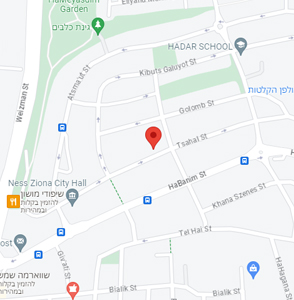
Amos Ilan is an Israeli advocate, admitted to the Israel Bar in 2003, and a notary licensed by the Ministry of Justice, licence no. 214444. The office is located at 17 Tzahal Street, Ness Ziyona, in central Israel, a short drive from Rehovot, Rishon LeZion and Tel Aviv. It serves private clients, companies and law firms, both in person and remotely throughout Israel, and works routinely in Hebrew and English.
Notarial translation, Hebrew and English
The largest part of this office's notarial practice is the certification of the correctness of a translation, a notarial act listed in section 7(4) of the Notaries Law, 5736-1976. In this certificate the notary states, on his own responsibility, that the translated text is a correct translation of the original document. Under Israeli law a notary may issue such a certificate only if the notary has command of both the source language and the target language, and has either prepared the translation or verified its accuracy.
The finished product is a printed certificate, bound together with the translation and with the original document or a copy of it, sealed with the notary's seal, ribboned and signed. This is the form of translation that Israeli and foreign authorities normally expect to see.
Certification of a translation is not the same as a translator's declaration
Two different documents are often confused, and the difference matters:
- Certification of the correctness of a translation. The notary personally vouches for the translation. This is the document most foreign consulates, universities, courts, immigration authorities and registrars require.
- Certification of a translator's declaration. The notary confirms only that a translator appeared before him and declared that the translation is accurate. The notary takes no responsibility for the content. It costs less, and it is not accepted by every authority.
Before ordering the cheaper option, check in writing which of the two the receiving body requires. If the instruction simply says "notarized translation", it almost always means the first.
Documents we translate and certify
Birth, marriage and death certificates. Extract from the Population Registry (Tamzit Rishum). Certificate of good conduct, also called a police clearance certificate. Matriculation certificates, academic diplomas and transcripts. Company documents such as a certificate of incorporation, articles of association or an extract from the Registrar of Companies. Powers of attorney. Judgments, divorce decrees and court orders. Medical records and doctors' letters. Driving licences. Bank confirmations and commercial contracts.
What a certified translation costs
Notary fees in Israel are not negotiable. They are fixed by the Notaries (Service Fees) Regulations, 5739-1978, and updated on 1 January each year in line with the Consumer Price Index. Every notary in Israel charges exactly the same amount for the same service, so the difference between one notary and another is availability, speed and quality of handling, never price.
For a certification of the correctness of a translation the fee is calculated by the number of words in the translation:
| Service | Fee, 2026 |
|---|---|
| Up to the first 100 words of the translation | 251 ₪ |
| Each additional 100 words, or part of them, up to 1,000 words | 197 ₪ |
| Each additional 100 words, or part of them, above the first 1,000 | 99 ₪ |
| Each additional certified copy issued at the same time | 77 ₪ |
VAT is added to every fee as required by law. A calculator that works out the exact fee for your document, by word count, is available on the Hebrew page Notarial Translation.
How it works
- Send a clear scan or photograph of the document by WhatsApp to 052-5927592, or by email.
- You receive a word count, the exact fee under the regulations and a delivery time, before any work begins.
- The translation is prepared and checked.
- The certificate is signed, sealed and bound, and is collected at the office or sent to you.
Most translations are ready on the same business day. You do not need to attend the office in person, and no identification is required for a translation certificate, because the notary is certifying the text and not a signature.
Apostille
If a certified translation is to be used abroad, the receiving country will usually also require an apostille. Israel is a party to the Hague Apostille Convention of 1961. An apostille on a notarial certificate is issued by the Magistrate's Court. An apostille on an Israeli public document itself, such as a certificate issued by the Ministry of the Interior, is issued by the Ministry of Foreign Affairs. The two are not interchangeable, and the order in which they are obtained matters. Tell us the destination country and the purpose, and we will tell you exactly which apostille your file needs.
What an Israeli notary is
A notary in Israel is not a clerk. The office is held by a veteran advocate appointed by the Minister of Justice after many years of practice, and the powers are defined by statute. A notarial certificate carries special evidentiary weight: the Notaries Law provides that it is sufficient evidence in legal proceedings, without further proof, of the notary's own statements and acts and of statements and acts made before the notary. That is why authorities and courts, in Israel and abroad, accept a notarial certificate at face value.
Other notarial services
- Authentication of a signature. The signatory appears before the notary with valid photo identification and signs in his presence.
- Certification of a copy as a true copy of the original. The original must be presented.
- Affidavits and declarations for use in Israel and abroad.
- A will made before an authority under the Succession Law, an unusually secure form of will.
- Financial agreement between spouses, whether a prenuptial agreement or an agreement made during the marriage, certified by a notary as an alternative to approval by the court.
- Irrevocable power of attorney for real-estate transactions, required by the Land Registry.
- Continuing power of attorney, the Israeli equivalent of a lasting power of attorney, drafted and deposited with the Administration of Legal Aid.
- Certificate that a person is alive, the life certificate required each year by foreign pension funds and social security institutions.
- Parental consent for a minor to travel abroad.
Main notary fees
| Service | Fee |
|---|---|
| Authentication of a signature, first signatory | 197 ₪ |
| Each additional signatory on the same document | 77 ₪ |
| Certification of a copy, first page | 77 ₪ |
| Each additional page of the copy | 13 ₪ |
| Affidavit, first deponent | 200 ₪ |
| Each additional deponent | 80 ₪ |
| Will made before an authority, first testator | 293 ₪ |
| Certificate that a person is alive | 197 ₪ |
| Financial agreement between spouses | 446 ₪ |
| Service performed outside the office, first hour | 645 ₪ |
Two surcharges set by the regulations are worth knowing. A service given between 19:00 and 08:00, or on a weekly rest day or a holiday, carries an addition of fifty per cent. A service given in a foreign language other than Arabic or English carries a fixed addition. The complete price list, in Hebrew, is on the pricing page.
Clients outside Israel
A significant share of the office's work is done for people who are not in Israel, or not in the centre of the country: Israelis living abroad, foreign nationals with Israeli documents, and law firms handling immigration, estate or corporate files. For a certified translation the whole process can be completed remotely. Send the scan, approve the quoted fee, and the signed certificate is dispatched. For services that require the client to appear in person, such as authentication of a signature or a will made before an authority, an appointment is set in advance so that there is no waiting.
Office, hours and contact
17 Tzahal Street, Ness Ziyona, Israel. In-house parking.
Telephone and WhatsApp: 052-5927592, or +972-52-5927592 from abroad.
Sunday to Thursday, 09:00 to 19:00. Friday, 09:00 to 12:30.
Frequently asked questions
Do I have to come to the office for a certified translation?
No. A certification of the correctness of a translation does not require the client to appear or to be identified. Send a scan and the signed certificate is sent back to you.
How long does it take?
Most translations are ready on the same business day. Long or technical documents may take longer, and you are told the delivery time together with the fee, before the work starts.
Can you certify a translation into a language other than Hebrew or English?
Certification of the correctness of a translation is given for Hebrew and English, the languages in which the notary has command. For other languages please contact the office, and the available options will be explained.
Is the notary's fee negotiable?
No. The fee is fixed by regulations and a notary is not permitted to charge more or less than the amount set there.
What is the difference between a notarial certificate and an apostille?
The notarial certificate authenticates the document, the signature or the translation. The apostille is a separate certificate, issued by a court or by the Ministry of Foreign Affairs, confirming to a foreign country that the notary holds office in Israel.
My document is already in English. Do I still need a notary?
If the document was issued in English there is nothing to translate, but the receiving authority may still require authentication of a signature, a certified copy or an apostille. Send it over and you will be told what is actually needed.
This page is general information about notarial services in Israel. It is not legal advice and does not replace advice on the facts of a specific matter.